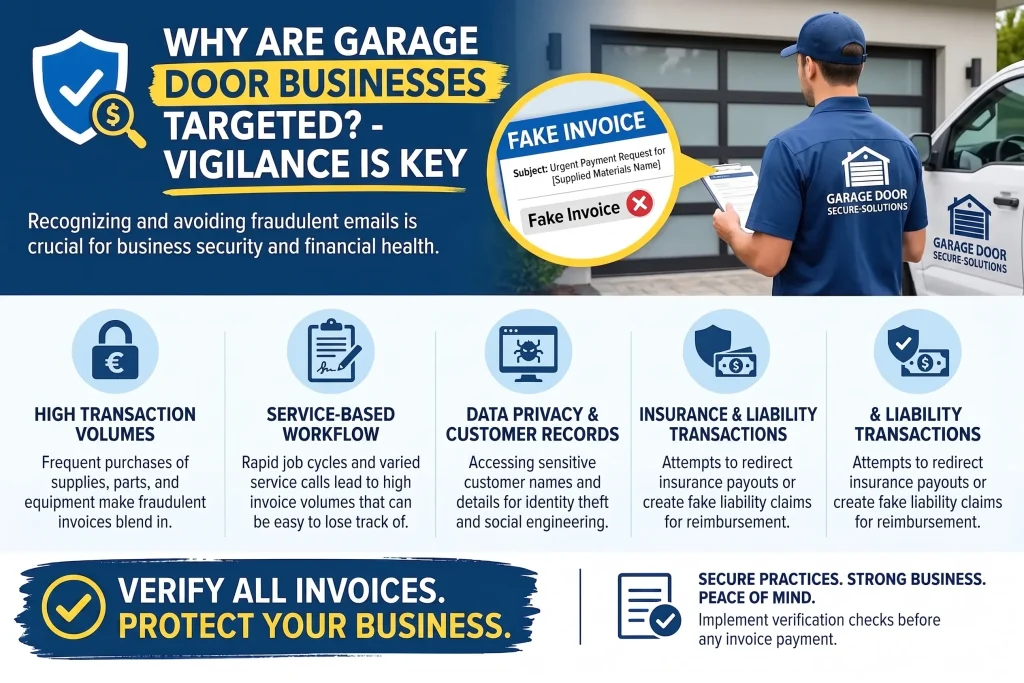
Garage door businesses are targeted by fake invoice emails because they regularly handle recurring payments to suppliers, subcontractors, and distributors, which gives scammers a familiar pattern to imitate. A fake invoice usually copies a real supplier’s format closely but swaps in new bank account or routing details, sometimes arriving as a reply inside a real email thread the scammer has already compromised.
The six clearest signs are a changed bank account or routing number, an invoice appearing mid-thread on an old conversation, payment details that don’t match past records, pressure to pay quickly, a sender address that’s slightly altered, and a request routed to someone other than the usual point of contact. A quick phone call before paying anything with new banking details stops nearly every version of this scam, whether it targets a garage door repair company or any other home-services business.
Key Takeaways
- Invoice fraud is the costliest phishing pattern for small home-services businesses because it targets money directly, not just credentials.
- A changed bank account or routing number attached to an existing vendor relationship is the clearest single warning sign.
- Scammers sometimes inject a fake invoice into a real, already-compromised email thread, making it look highly convincing.
- Always confirm new or changed payment details by phone, using a number you already have on file, before paying anything.
- Many banks can reverse a wire transfer within a narrow window, so speed matters if a fraudulent payment does go out.
- Keeping a written record of verified payment details for regular vendors makes it easy to spot when something’s changed.
Real Invoice vs. Fraudulent Invoice
| Signal | Real Invoice | Fraudulent Invoice |
| Bank details | Match what you’ve paid to before | Recently changed, no prior notice by phone |
| Email thread | Starts fresh or continues a thread you recognize | Appears as a reply buried in an old thread |
| Format | Matches that vendor’s usual invoice layout | Slightly different layout, logo, or numbering |
| Urgency | Normal payment terms, no unusual pressure | Pressure to pay quickly to avoid a penalty or delay |
| Contact | Comes from the same person or department as usual | Routed to a different employee than normal |
6 Signs of Payment Fraud Phishing Targeting Garage Door Businesses
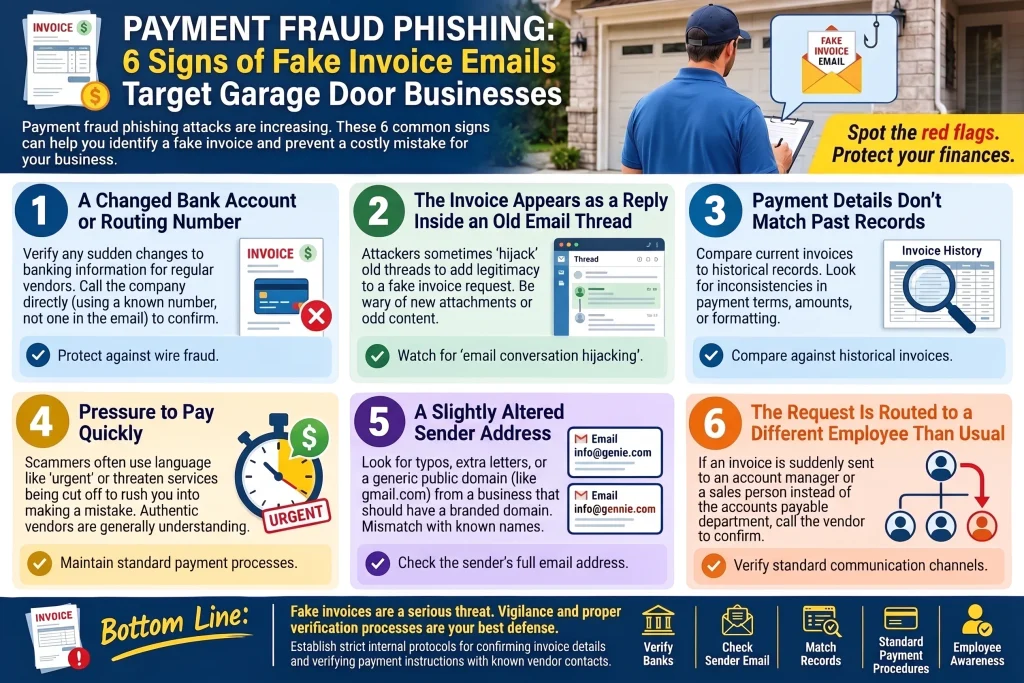
1. A Changed Bank Account or Routing Number
How to fix a request to change payment details: Treat any change to a bank account or routing number as unverified until you’ve confirmed it by phone with a contact you already trust, using a number you already have on file rather than one in the email.
This is the single biggest red flag in invoice fraud. A legitimate vendor rarely changes banking details without some form of direct outreach beyond an email alone.
Warning signs of a changed bank account or routing number:
- New account or routing number attached to an existing, recurring invoice
- No prior phone call or written notice about the change
- Email explains the change as a “recent update” or “new processing bank”
- Request to update your records “right away” before the next payment
What to do if payment details changed unexpectedly:
- Call the vendor or subcontractor directly using a known number, not one from the email
- Confirm the change verbally before updating anything in your accounting system
- Keep a record of verified payment details so any change stands out immediately
Invoice and payment fraud has become common enough industry-wide that the International Door Association now maintains a Scam Awareness resource with reporting steps for businesses that get targeted.
2. The Invoice Appears as a Reply Inside an Old Email Thread
How to spot an invoice injected into a compromised thread: Be cautious of any invoice that shows up as a reply to a months-old conversation, since this usually means the sender’s real email account has already been compromised.
Scammers who gain access to a real inbox often reply to old threads because it makes the message look legitimate at a glance, complete with real prior conversation history.
Warning signs of a compromised email thread invoice:
- Invoice attached to a thread that’s much older than the current conversation
- Writing style or tone doesn’t quite match how that contact usually writes
- Thread includes a payment request that wasn’t part of the original conversation
- Sender pushes to move the conversation to a new email address
What to do if an invoice appears in an old email thread:
- Call the sender directly to confirm the invoice; don’t reply within the same thread
- Ask if their email account has had any unusual activity recently
- Flag the thread to your IT contact if anything about it feels off
This is just one of the patterns targeting businesses like yours; the full picture is covered in How Can a Garage Door Business Protect Itself From Phishing Emails?
3. Payment Details Don’t Match Past Records
How to fix a mismatch between new and past payment details: Compare the invoice against your records of that vendor’s past payment details, and treat any difference as a reason to verify by phone before paying.
Keeping a simple record of verified banking details for your regular vendors makes this comparison quick and turns a potential loss into a five-minute phone call.
Warning signs of mismatched invoice payment details:
- Bank name, account number, or routing number differs from what you’ve paid before
- Invoice number format doesn’t match that vendor’s usual sequence
- Company name on the invoice is slightly different from the legal name you have on file
- Remit-to address has changed without prior notice
What to do if invoice details don’t match past records:
- Keep a simple log of verified payment details for regular vendors and subcontractors
- Compare every invoice against that log before paying, especially for larger amounts
- Call to confirm any mismatch before processing payment
4. Pressure to Pay Quickly
How to handle urgency in a payment request: Slow down and verify by phone before paying anything under time pressure, since legitimate vendors rarely threaten immediate penalties over a routine invoice.
Urgency is one of the most consistent tactics across nearly every phishing pattern, and invoice fraud is no exception.
Warning signs of invoice payment pressure tactics:
- Threat of a late fee, order hold, or account suspension if payment isn’t immediate
- Language discouraging you from calling to confirm (“please process without delay”)
- Deadline that’s unusually tight compared to that vendor’s normal payment terms
- Message sent outside normal business hours, pushing for a same-day response
What to do about urgent invoice payment requests:
- Confirm by phone before paying anything with an unusually tight deadline
- Remember that a short delay to verify is far less costly than a fraudulent payment
- Document the pressure tactics used if you report the attempt afterward
This same urgency tactic is the core of owner impersonation attempts too, so it’s worth reading Why Do Scammers Impersonate the Owner in Garage Door Business Phishing Emails? 5 Signs of CEO Fraud as well.
5. A Slightly Altered Sender Address
How to spot a lookalike sender address on an invoice email: Check the full email address behind the display name, looking for an extra letter, number, or different domain extension than that vendor normally uses.
Just as with vendor phishing, invoice fraud often relies on a domain that looks correct at a glance but doesn’t match exactly once you look closely.
Warning signs of a fake invoice sender address:
- Display name matches a known contact, but the underlying address doesn’t
- Domain extension differs from what that vendor normally uses
- Reply-to address is different from the sender address shown
- Slight misspelling in the company name within the email address
What to do if the invoice sender address looks altered:
- Tap or click the sender’s name to reveal the full email address before responding
- Compare it against a previously verified email from that same vendor
- Report and block the sender once a mismatch is confirmed
Vendors themselves get spoofed the exact same way, which is why it’s worth also reading Why Do Scammers Send Fake LiftMaster and Clopay Vendor Emails to Garage Door Companies? 5 Signs of Vendor Phishing.
6. The Request Is Routed to a Different Employee Than Usual
How to fix a payment request sent to an unusual recipient: Treat any invoice or payment request sent to someone outside your normal accounts payable process as a reason to verify with the usual contact before acting.
Scammers sometimes target newer employees or those less familiar with a vendor relationship, since they’re less likely to notice something’s off.
Warning signs of a misrouted invoice request:
- Invoice sent to an employee who doesn’t normally handle that vendor
- Message asks that employee to “handle this one directly” without looping in the usual contact
- Recipient has no prior email history with the sender
- Request arrives while the usual contact is known to be out of office
What to do if an invoice is sent to the wrong employee:
- Loop in whoever normally manages that vendor relationship before acting
- Train the whole accounts payable team on this pattern, not just one person
- Treat “handle this directly” language as a reason to pause, not proceed
Call a pro (your bank’s fraud department, immediately) if a payment has already been sent to an account that turns out to be fraudulent. For ongoing updates on scam patterns affecting the industry, the International Door Association posts scam-awareness updates on LinkedIn worth following.
Protecting Your Payment Process From Invoice Fraud
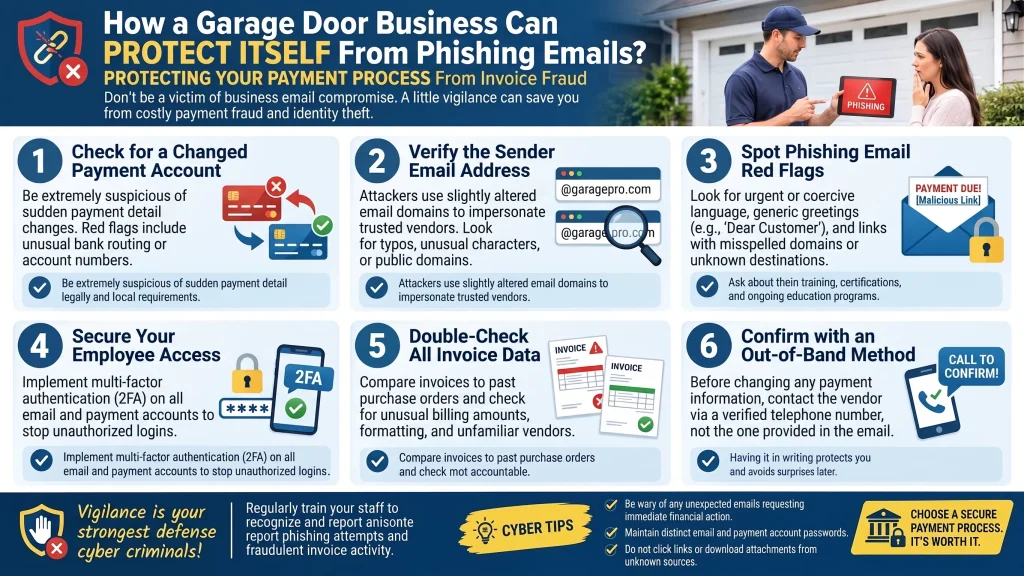
Invoice fraud succeeds because it looks routine, a normal payment to a normal vendor, until the money lands in the wrong account. A simple habit of verifying any change to payment details by phone closes off nearly every version of this attempt before it costs you anything.
Bradbury Garage Doors handles these same vendor and subcontractor payments every week, and we’ve built phone verification into how our office processes anything involving a bank detail change. If you’d like a second set of eyes on your payment verification process, contact us today, or give us a call.
Frequently Asked Questions
Can a bank actually get money back after a fraudulent wire transfer?
Sometimes, if you catch it quickly and call your bank's fraud department right away. Speed matters a lot here, so don't wait to report it.
Why would a scammer reply inside a real, old email thread?
It's usually because that email account has already been compromised, and replying inside an existing thread makes the fake invoice look far more convincing than a cold email would.
Should we keep a written list of verified payment details for our vendors?
Yes, that's one of our rules of thumb in the office. A simple log makes it easy to catch a change the moment it happens, rather than after a payment goes out.
What if the invoice looks legitimate but the deadline feels unusually urgent?
Urgency alone is enough of a reason to verify by phone before paying, regardless of how legitimate the rest of the invoice looks.
Is it common for scammers to target a newer employee instead of the usual contact?
Yes, in our experience, that's a deliberate tactic, since someone less familiar with a vendor relationship is less likely to notice something's changed.
How much does invoice fraud typically cost a small business?
Losses vary widely depending on the payment amount and how quickly it's caught, ranging from a minor inconvenience to a significant loss if a large payment goes through unverified.
Do we need accounting software with built-in fraud detection?
It can help, but in our experience, a simple habit of phone verification for any payment detail change catches most of what software alone would miss.
What should we do if we already paid a fraudulent invoice?
Call your bank's fraud department immediately, and separately notify the real vendor, so they're aware their identity or email may have been used.
Who in our office should be responsible for verifying payment changes?
Whoever normally manages accounts payable, with a backup person who also knows the verification process in case the primary contact is unavailable.