
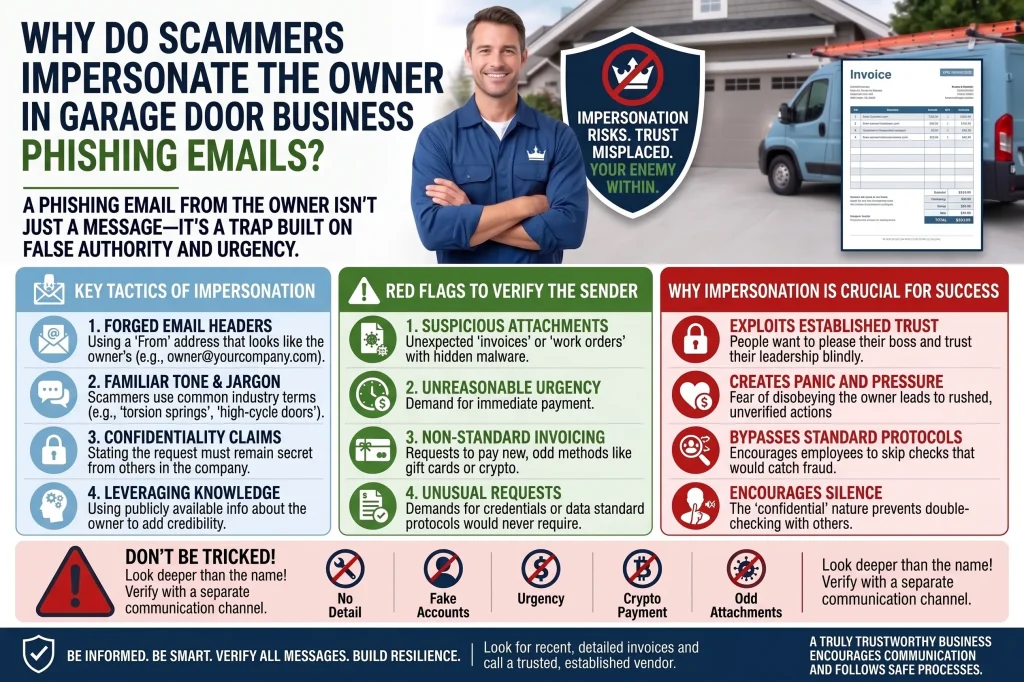
Scammers impersonate the owner in garage door business phishing emails because employees are far less likely to question a request that appears to come from someone in charge, especially when it’s framed as urgent and confidential. The email usually asks an employee to buy gift cards, wire funds, or send sensitive payroll information quickly, often outside normal business hours, and discourages the employee from checking with anyone else first.
The five clearest signs are a display name that looks right but an email address that doesn’t match, requests for gift cards or wire transfers, language asking to keep the matter quiet, timing outside normal hours, and a request routed to someone who wouldn’t normally handle that kind of task. A short phone or text confirmation, separate from email, stops nearly every version of this scam at any garage door repair business.
Key Takeaways
- CEO fraud works by exploiting authority and urgency, not technical sophistication.
- A mismatched email address behind a correct-looking display name is the most reliable technical sign.
- No legitimate owner or manager asks to be paid back in gift cards, ever.
- Any financial request that arrives only by email should be confirmed by phone or text before anyone acts.
- Scammers often target employees less familiar with how the owner normally communicates.
- A simple team policy, verify anything unusual by a channel other than email, closes off nearly every version of this scam.
Real Owner Request vs. Impersonated Owner Request
| Signal | Real Owner Request | Impersonated Owner Request |
| Email address | Matches the owner’s actual address exactly | Display name looks right, address doesn’t match |
| Payment method | Normal business payment methods | Gift cards, wire transfers, unusual payment apps |
| Tone | Consistent with how that person normally writes | Urgent, secretive, or unusually formal |
| Timing | Sent during normal business hours in most cases | Sent late at night, early morning, or on a weekend |
| Verification | Comfortable with a phone call to confirm | Discourages calling, asks to “handle it quietly” |
5 Signs of CEO Fraud Targeting Garage Door Businesses
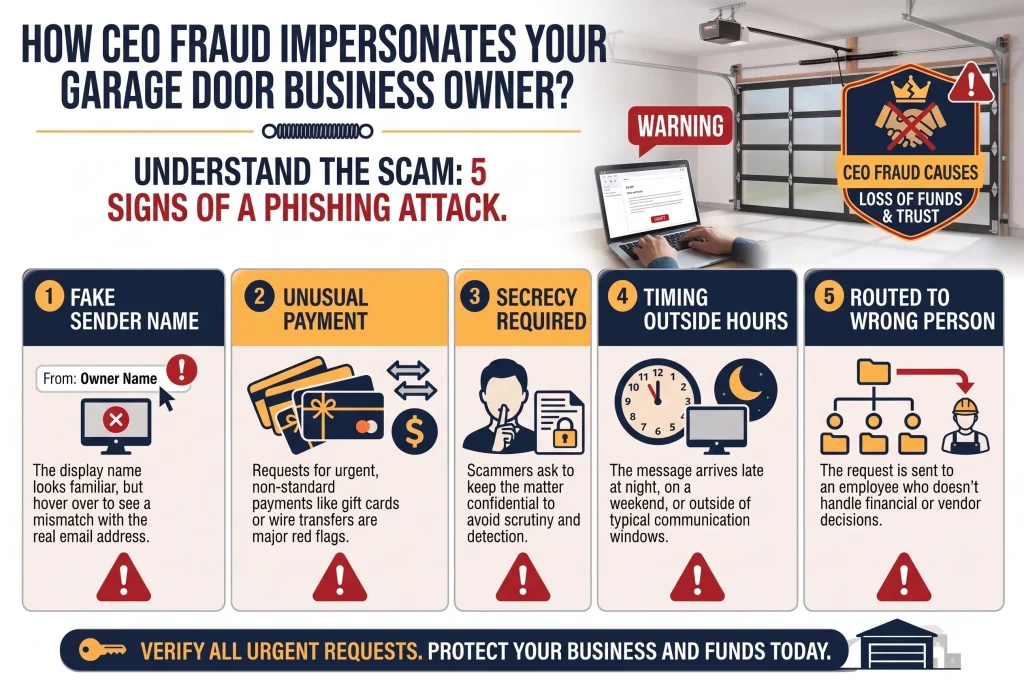
1. The Display Name Looks Right, but the Email Address Doesn’t Match
How to spot a mismatched owner email address: Tap or click the sender’s name to reveal the full email address, and compare it directly against the owner’s actual address rather than trusting the display name alone.
Most email programs show only a display name by default, so a scammer can set that name to match the owner exactly while the underlying address is completely different.
Warning signs of a fake owner email address:
- Display name reads correctly, but the address doesn’t match when checked
- Domain differs slightly from the company’s actual email domain
- Reply-to address is different from the address shown as the sender
- Message arrives from a free email service instead of the business domain
What to do if the owner’s email address doesn’t match:
- Check the full email address before responding to any unusual request
- Save the owner’s verified email address so it’s easy to compare against
- Confirm by phone or text if anything about the address looks even slightly off
Vendors face this same lookalike-address trick, which is exactly why Why Do Scammers Send Fake LiftMaster and Clopay Vendor Emails to Garage Door Companies? 5 Signs of Vendor Phishing is worth reading too.
2. The Request Involves Gift Cards or a Wire Transfer
How to fix a request for gift cards or a wire transfer: Treat any request to purchase gift cards or send a wire transfer as highly suspicious, since no legitimate business owner asks to be paid back this way.
This is one of the clearest and most consistent signs across CEO fraud attempts. Gift cards are especially popular with scammers because they’re difficult to trace and nearly impossible to recover once the codes are sent.
Warning signs of a gift card or wire transfer scam:
- Request to purchase gift cards and send the codes by email or text
- Wire transfer request framed as urgent, often tied to a vendor or a deal closing
- Message specifies an unusual payment amount or method compared to normal operations
- Follow-up messages pushing for a status update on the purchase or transfer
What to do about gift card or wire transfer requests:
- Refuse any gift card request outright; this is never a legitimate business payment method
- Confirm any wire transfer request by phone using a number you already have on file
- Let your team know this pattern exists so no one feels caught off guard
Gift card and wire scams are only one piece of a bigger threat landscape, so it’s worth reading How Can a Garage Door Business Protect Itself From Phishing Emails? to see the full range of attacks your team should watch for.
3. Language Asking to Keep the Matter Quiet
How to handle a request to keep something confidential: Treat “keep this between us” or similar language as a reason to verify through another channel, not a reason to avoid asking questions.
Scammers use confidentiality framing to prevent an employee from checking with a coworker or manager who might recognize the request as suspicious.
Warning signs of a confidentiality-based CEO fraud request:
- Explicit request not to mention the task to anyone else
- Framing around a “surprise,” a “confidential deal,” or a “sensitive personnel matter”
- Discouragement from calling to confirm, with reasons like being in a meeting or unreachable
- Pressure to respond only by email rather than by phone or in person
What to do if asked to keep a request quiet:
- Treat confidentiality requests as a reason to verify, not a reason to stay quiet
- Check with a coworker or manager even if asked not to, especially for anything involving money
- Report the attempt to whoever it impersonated once confirmed fake
This exact pressure tactic is common enough that the International Door Association maintains a Scam Awareness resource covering how businesses can report and respond to it.
4. The Message Arrives Outside Normal Business Hours
How to fix suspicion around off-hours owner requests: Treat any unusual request that arrives late at night, early morning, or on a weekend with extra caution, and wait to confirm by phone during normal hours if the request isn’t truly time-sensitive.
Scammers often send these messages when they expect people to be less alert or less able to verify quickly, counting on someone acting out of habit rather than double-checking.
Warning signs of an off-hours CEO fraud email:
- Message timestamp falls well outside normal business hours
- Request claims the owner is traveling, in a meeting, or otherwise hard to reach
- Urgency framed around a deadline that conveniently falls before anyone can verify
- Follow-up messages sent in quick succession pushing for a response
What to do about off-hours owner requests:
- Wait to confirm by phone during normal hours unless there’s a genuine emergency
- Remember that real urgent business matters can usually tolerate a short verification call
- Flag repeated off-hours requests to your team as a pattern worth watching for
For ongoing scam-awareness updates from the industry’s leading trade association, the International Door Association posts regularly on LinkedIn and is worth following.
5. The Request Is Routed to Someone Who Wouldn’t Normally Handle It
How to fix a mismatched task assignment in an owner impersonation attempt: Treat any financial or sensitive request sent to an employee outside their normal role as a reason to loop in a manager before acting.
Scammers often research who’s likely to have access to funds or sensitive information but may be less familiar with how the owner typically delegates tasks.
Warning signs of a misrouted CEO fraud request:
- Request sent to an employee who doesn’t normally handle payments or sensitive data
- Task doesn’t match that employee’s usual responsibilities
- No prior working relationship between that employee and the “owner” on similar tasks
- Message implies the employee was chosen specifically because they’re “available” or “trusted”
What to do if a financial request is routed unusually:
- Loop in a manager or coworker before acting on anything outside your normal role
- Build a simple team policy: unusual requests get a second opinion before action
- Report the pattern so newer employees know what to watch for
Call a pro (your IT provider or a cybersecurity consultant) if you’re unsure whether an email account, including the owner’s, has already been compromised. This same misrouted-request tactic shows up in invoice fraud too, so it’s worth reading Why Are Garage Door Businesses Targeted by Fake Invoice Emails? 6 Signs of Payment Fraud Phishing as well.
Protecting Your Team From Owner Impersonation
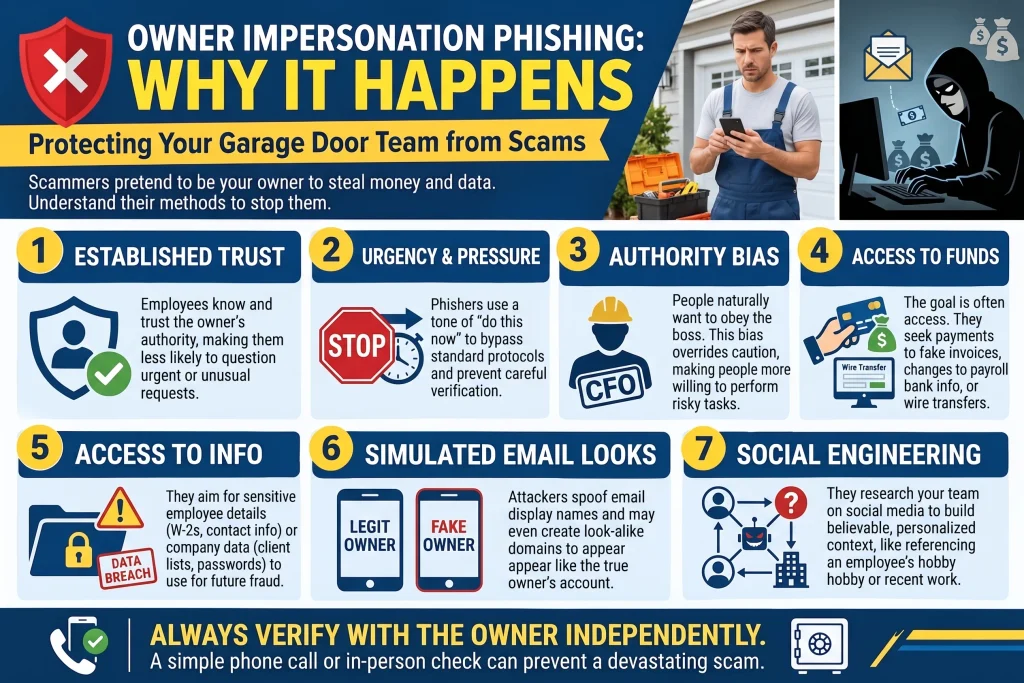
CEO fraud works because it borrows trust and authority that already exists inside your business. A simple habit, verifying anything unusual through a phone call or a text rather than replying to the same email, closes off nearly every version of this attempt before it costs anyone anything.
Bradbury Garage Doors has built this verification habit into how our own office operates, since a small team like ours is exactly the kind of target these scams are built for. If you’d like help building a simple verification policy for your own team, contact us today, or give us a call.
Frequently Asked Questions
Is it ever legitimate for an owner to ask for gift cards?
No. In our experience, this is one of the clearest signs of a scam we see in the field, and no legitimate business payment works this way.
What should I do if I already sent gift card codes or wired money before realizing it was a scam?
Contact your bank's fraud department immediately if a wire was involved, and report gift card fraud to the retailer as soon as possible, since some can freeze the cards if caught quickly.
Why do these scams often arrive outside normal business hours?
In our experience, scammers count on people being less alert or less able to verify quickly outside normal hours, which makes off-hours timing a useful warning sign.
What's our rule of thumb when a request asks to "keep this quiet"?
We treat that language as a reason to check with someone else, not a reason to stay quiet. Real confidential matters can usually tolerate a quick verification call.
Should new employees be told about this scam pattern during onboarding?
Yes, we think that's worth including early, since scammers often target people less familiar with how leadership normally communicates.
Can this happen even if our email accounts have strong passwords?
Yes. Many of these emails don't require any account to be compromised at all, since they simply fake a display name and an urgent request.
How much does it cost to set up better protection against this kind of scam?
Costs vary depending on your setup, ranging from no cost at all for a verification policy you write yourselves to a modest fee for outside security training. Training and habits matter more than any specific tool here.
What if the request seems small, like a minor purchase, not a huge wire transfer?
Verify it anyway. In our experience, small requests are sometimes used to test whether an employee will comply before a larger request follows.
Who should employees talk to if they're not sure whether an "owner" request is real?
Whoever they'd normally check with on a financial matter, or the owner directly through a phone call or text, not a reply to the same email.